



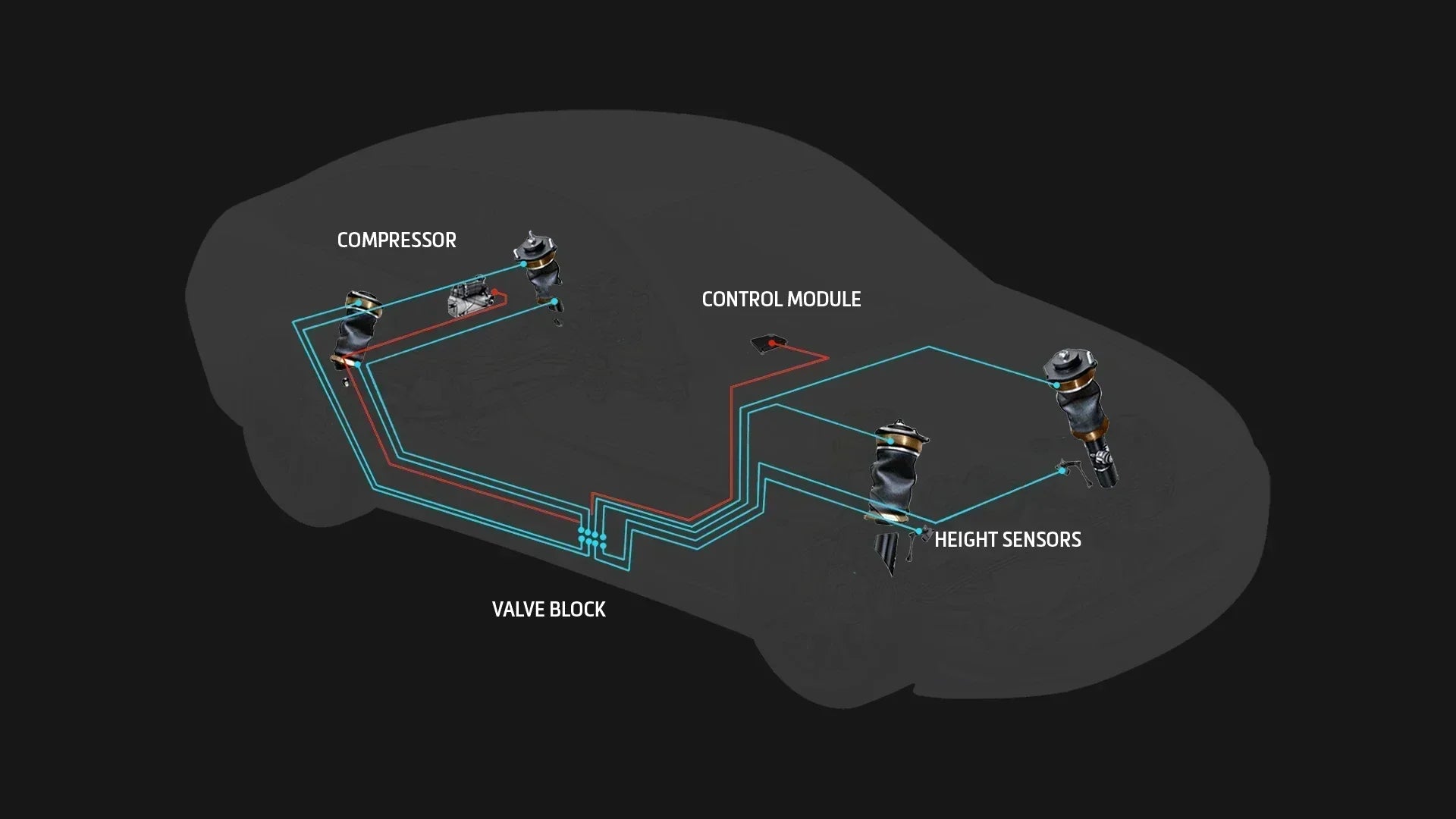
As the automotive industry continues to prioritize drivability, safety, and ride comfort, suspension technology plays a central role in achieving those goals. Air suspension systems, once reserved for luxury platforms, are now appearing across a broader range of vehicles, including popular import models and electric vehicles.
For today’s automotive professionals, understanding how air suspension systems operate is no longer optional. As coverage expands, so do opportunities for accurate diagnostics, efficient repairs, and increased service revenue. A solid working knowledge of these systems helps technicians diagnose issues faster, recommend the right repairs with confidence, and avoid costly comebacks.

System Overview
A typical air suspension system consists of seven primary components:
-
Air Struts or Air Springs
-
Compressor
-
Valve Block
-
Reservoirs
-
Ride Height Sensors
-
Electronic Control Unit (ECU)
Each component plays a specific role, and all must function together to maintain proper ride height, comfort, and vehicle stability. As air suspension becomes more common, aftermarket manufacturers like Arnott invest heavily in OE benchmarking and real-world vehicle testing to ensure precise fit, function, and long-term reliability.
Below is a breakdown of each major component and its contribution to overall system operation.
Air Struts & Air Springs
Air struts and air springs are responsible for raising and lowering the vehicle and supporting its weight. Depending on the platform, the system may use:
-
A standalone air spring paired with a separate shock absorber, or
-
A complete air strut assembly that integrates both functions
The air spring bears the vehicle load, while the shock absorber controls damping and absorbs road impacts. Together, they maintain proper ride height, improve handling, and adapt to changing loads. These components rely on a reinforced rubber air sleeve to contain pressurized air, making material quality critical.
Well-engineered air springs and struts use multi-ply rubber, Tier 1-grade components, and undergo extensive durability testing. High-quality aftermarket options, such as those from Arnott, are designed to meet or exceed OE performance while offering long-term reliability.
Pro Tip: Always support the vehicle when inflating air springs or struts. Allowing the suspension to hang can cause the air spring to bend during inflation, placing stress on the air sleeve and potentially pulling it out of the crimping ring.
Compressor
The compressor supplies and regulates the air pressure required to maintain the vehicle’s preset ride height. When ride height sensors detect a deviation, the ECU activates the compressor to add or remove air as needed.
Many compressors include an integrated dryer to remove moisture from the system, an essential feature for extending the service life of both the compressor and other air suspension components. Most Arnott compressors include a dryer as standard equipment.
Pro Tip: If a compressor runs continuously or fails prematurely, inspect the air struts or springs for leaks. Persistent leaks force the ECU to command constant operation, which can overload and damage the compressor.
On systems equipped with a pressure reservoir, the compressor's primary role is often to maintain reservoir pressure rather than respond to every individual ride-height change, further reducing the duty cycle and heat-related wear.
Although most compressors look identical on the outside, internal design, materials, and testing standards vary widely. High-quality compressors are designed to meet strict performance requirements and undergo extensive lifecycle testing.
Valve Block
The valve block manages airflow throughout the system. Based on ECU commands, it directs pressurized air to inflate or deflate individual air struts or springs. Each corner of the vehicle is controlled by a dedicated valve.
When inflating, air flows from the compressor through the valve block to the appropriate suspension component. When deflating, air returns to the valve block and is released through a pressure-relief valve or routed to a pressure reservoir if the system is equipped with one.
Pro Tip: If a vehicle sits lower on one corner, the issue may be a leaking air spring or a faulty valve block. Swapping the suspected air line at the valve block can help isolate the problem. If the low corner changes, the valve block is likely at fault; if not, suspect an air leak.
Reservoirs
While not standard on every air suspension system, reservoirs (also called air tanks) play an important role on platforms that use them. A reservoir stores pressurized air, allowing the system to adjust ride height frequently and quickly without relying solely on the compressor.
By supplying pre-pressurized air, the reservoir reduces the frequency and duration of compressor operation. This helps minimize heat buildup, reduce electrical load, and significantly minimize compressor wear. Vehicles equipped with a reservoir often deliver faster, smoother height changes and improved system efficiency, particularly during repeated adjustments such as load leveling or dynamic ride height control at varying speeds.
During deflation events, some systems route excess air back into the reservoir rather than venting it to the atmosphere, thereby further improving efficiency. While reservoirs add complexity and cost, they are a key durability and performance feature on many higher-end and performance-oriented air suspension systems.
Ride Height Sensors
Ride height sensors provide the ECU with real-time data on vehicle body position. This information allows the ECU to determine whether adjustments are needed and where air should be added or removed.
Because these sensors operate continuously and are exposed to harsh conditions, durability is critical. Look for features such as direct plug-and-play installation and lab testing rated for up to one million cycles.
Pro Tip: Before removing air struts or shocks, disconnect the ride height sensor from the axle mount. Failing to do so can overextend the sensor beyond its limited rotation range, causing damage to the sensor rod.
Electronic Control Unit (ECU)
The ECU is the command center of the air suspension system. It processes input from ride height sensors while monitoring factors such as vehicle speed, acceleration, and system pressure. Based on this data, the ECU determines whether individual air springs or struts need to be inflated or deflated to maintain the target ride height.
Once a decision is made, the ECU sends commands to the compressor and valve block to execute the adjustment.

The Benefits of a Fully Functioning System
While low-cost aftermarket components may appear similar at first glance, material quality and engineering differences can lead to reduced burst pressure, poor fitment, increased NVH, and shortened service life. High-quality suspension components use superior materials, validated designs, and rigorous testing to deliver OE-like performance and reliability.
For installers seeking to deepen their understanding of modern air suspension systems, ongoing technical education is increasingly valuable. Programs like the Air Suspension Academy help technicians stay current on system operation, diagnostics, and best practices as these technologies continue to expand across the vehicle landscape.
New Suspension Releases for November
Arnott Suspension Product Release: February Updates for eRide and Air Systems